Considering Vietnam as a case study of National Aesthetics, the country had “two decades of rapid growth following the adoption of Doi Moi or ‘economic renovation’ announced in December 1986” (Pincus 29). However, Vietnam has not been growing very fast since 2007. Vietnam is still dependent on the imports from China, such as fabric, steel, and chemicals, that it does not show interests in competing against the Chinese producers and other upstream industries. It exported a lot of footwear in 2011 that it was in third place behind China and Hong Kong, but the country was still growing slowly. Besides exporting footwear, Vietnam exports large amounts of agriculture especially green coffee and rice, but the crops are cheap and the quality is not that good. This indicates that agriculture may be a plausible branding project that reflects Vietnam’s aesthetics, but Vietnam would need to increase its strengths and decrease or change the weakness into strength. A weakness that is related to agriculture is how the companies discourage the links between the producer, processor, and consumers. By changing the agricultural process, Vietnam can use agriculture to brand their country in a positive light and grow faster.
Moreover, transnational education may be a plausible branding product for Vietnam since it can help expand education in the country. Having an education from an institution from another nation can increase a person’s knowledge and find other ways to solve problems. However, the Vietnamese government is not branding transnational education in an affective way that it has become “complex, ambiguous, opaque and poorly implemented and monitored” (Nguyen & Shillabeer 644). They are just tell the whole world that they have transnational education instead of enhancing the education. As a result, Vietnamese students are not getting good service quality for their education.
Some countries, like China, Europe, and the U.S., could help facilitate Vietnam’s development since these countries have some relations with Vietnam and are more developed as a country. These countries could give some tips to Vietnam so that they could strengthen their brands and decrease their weaknesses. Many times, these are also the countries where Vietnamese students would want to study from. The knowledge that the Vietnamese students bring back to Vietnam can help the country develop more and understand other nations better that there are less conflicts.
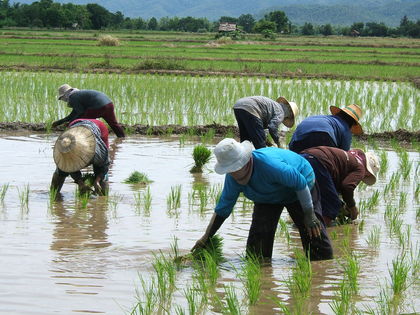
Question: How come Vietnam have not shown much interest in competing with Chinese producers and other upstream industries in things like yarn, cloth, and steel?
Works Cited
http://www.nationsencyclopedia.com/photos/vietnam-agriculture-1349.jpg
Nguyen, G., & Shillabeer, A. (2013) Issues in Transnational Higher Education Regulation in Vietnam. Proceedings of the International Conference on Managing the Asian Century, 637-644.
Pincus, J. (2015). Why Doesn’t Vietnam Grow Faster? State Fragment and the Limits of Vent for Surplus Growth. Journal of Southeast Asian Economics, 32, 26-51.
Monday, November 27, 2017
Week 10- Kristina Ou
When reading the articles about rebranding for
Vietnam, there were many challenges but also positive issues surrounding the
country. In particular, the article by Nguyen and Shilabeer focuses on the
issue of transnational education. Vietnam is focusing on the expansion of
education, but the government is not overseeing it correctly. Instead of trying
to enhance the education, they are just trying to brand that they have
transnational education without expanding it. In the article involving the
growth of Vietnam, it states how Vietnam has become so large with exporting of
agriculture, but how companies have cut a relation between consumer and
producers. This has caused less communication occurring with products. Both
towards manufacturing and agriculture, they are both not being utilized in a
successful manner to help in the progression of Vietnams rebranding.
Some groups that can domestically
or internationally facilitate is having interns from America to Vietnam to
teach English to students in Vietnam. In the article, it states that many
people have a hard time trying to locally receive higher education especially
in terms of other languages such as English. With interns coming from abroad,
there would be that external teacher that can help teach the students and
actually progress with the transnational education.
Nguyen, George. Anna Shillabeer. "Chapter 71 Issues in Transnational Higher Education Regulation in Vietnam."
Sunday, November 26, 2017
Week 10 Kenrick Chiang
When looking at the articles discussing the branding of Viet Nam, it seems like the country should focus on their strengths in order to give itself any form of branding. However, it should also focus on improving its major downfalls. In Pincus’s article about why does Vietnam not grow faster, he discusses how Vietnam’s agriculture is one of its key strengths, but they do not take use of this strength to its fullest potential. Different crops such as fish, coffee, peppers, etc. are very well produced in Vietnam, but in order to fully make use of these crops, they should open up more trade with different parts of the world. In Nguyen’s and Chilabeer’s article about the education in Vietnam, they discuss how Vietnam’s regulations are poorly monitored. Rather than just implementing something as big as covering TNE, in order to give itself a good branding, Vietnam should focus on giving some form of structure so their weaknesses won’t fall, while improving its strengths.
Something to consider is to focus on its agriculture, because when seeing how much Vietnam has grown solely off of agriculture, Vietnam could definitely give itself a more feasible branding. Agriculture is something that is a part of culture, so by pushing for more access to their foods around the world, it would definitely help a lot. Comparing it to the country of my focus, China, it is a country that has spices and foods all over the world, making China have their own branding of a specific type of food.
Question: Based on different factors, how fast do people think Vietnam can get its branding? Years? Decades?
Week 10: Nancy Bui

The current slogan for Vietnam is "Timeless Charm." This slogan can be interconnected to notions of curiosity, quirkiness, and yet elegance that works to entice potential tourist to Vietnam .Valverde's article revolves around the historical context and platform in which trans nationalism propelled through the displacement of Vietnamese people globally. They highlight the emphasizes of influence among Vietnamese diaspora through platforms such as music production, "Pairs by Night, Kim Lo, Trung Tam Asia" (Valverde). This type of "ethnic news media can shift the limits of acceptable cultural production." (Valverde) So as this new forums of music production influence Vietnamese & Vietnamese Americans, it dictates the new formed boundaries and therefore can set platform for connections between all. " Vietnamese music exhibits a special blend of nostalgia tht appeals to not only members of the diaspora community, but also residents of Vietnam." (Valverde)
From Shillabeer and Nguyen's article, it has highlighted the notions of transnational education in which it is people, program, and institution mobility based education. These can become or continue becoming the new platform in which the new branding is reinforced. The notion of exploration, education, diversity, and uniqueness through each of these strategic platforms can potentially speak widely to Vietnam's intentions and presentation to the world.
Some major players that could potentially facilitate Vietnam's development could be those who are host countries through Vietnam's education "study abroad" programs such as the United States, Japan, and Canada. Means of understandings between many nations can potentially set basis for growth and development of Vietnam's education/institutions in which other practices globally can be learnt and referred back to the homeland in which these practices can be initiated to ensure sustainability (or at least steps toward sustainability.)
Blog Question: How does other platforms (such as new coming social media) affect the Vietnamese Diaspora and what are the potential impacts as technology continues to produce more accessible means of communication (and therefore impact/influence)
References
Valverde, Kieu-Linh Caroline. “Introduction: Transnationalizing Viet Nam, Community Culture and Polictics in the Diaspora" 2012 pp. 1-28
Nguyen, George. Anna Shillabeer. "Chapter 71 Issues in Transnational Higher Education Regulation in Vietnam.". N.p. n.d. 637-44. Print.
Photo Cited
Rewire. News. "How Labor Movements Are Around the World Interconnected, Sept. 2013. Web. 26 Nov. 2017.
Monday, November 20, 2017
Week 9-Kristina Ou
Many countries will lie and promote untruths so that they will not be seen in a bad light so that they can be successful and prosperous. For Vietnam, Agent Orange was a chemically used to kill off crops and poison the land in the area. This affected the people living in the areas as well as the generations after which caused birth defects and medical disabilities. The US tried to cover this act up by questioning the evidence that was presented saying that there may not be real evidence. This affected the nation branding of how Vietnam was seen and affected their lives/futures. The US also did not account for the actual Vietnamese citizens living in the land but only the Vietnamese Americans and the veterans. They only provided benefits for the people falling within those categories. Since this tactic was an illegal move, they tried to hide what they did.
In terms of our project, we’re focusing on local businesses and how they are pushed aside by big companies. This relates completely with what we are trying to make as the app because big corporations will do anything to become successful including buying out small businesses for rent. They may also try to ruin small businesses and lie about what they are doing so that they could take over the shops as well. Big corporations may also lie about the ingredients that they use in their foods and supplies because they mass produce many of the goods.
Question: Why is there not as much focus on trying to uncover the truths of these nations?
Sources:
https://static01.nyt.com/images/2014/05/09/multimedia/retro-agent-orange/retro-agent-orange-superJumbo.jpg
Sunday, November 19, 2017
week 9 Bin Xiao
In reality, there are many ways to arrive at the concept of identity. One of the methods is through aesthetics. It appears as if aesthetic is injected in all cultures. In China, for example poetry narrated eyebrows as if they were willow leaves. In Japan paintings are observed to be celebrating women with extremely white skins and rosebud shaped lips. There are many ways in order to remake a country’s identity especially after a tragedy. In order to achieve maximum national aesthetic status, then an object must carry the country’s values. It serves as the representation of the past, present and future of the nation. This is not only a simple symbolism but carries with it national identity.
What happened in Vietnam, for instance, is an example of how a horrifying incident inculcated itself into the identity of the nation. The case of the herbicide involving the US Army showed many cover-ups and lies in attempt to lessen the negative reaction of the public towards the event. However, it is shown that the compensation given to the victims is inadequate (Palmer, 1). There were many medical consequences such as residents registering high level of level of dioxin in the blood streams of the residents (Palmer, 1062).
The readings showed how Asian communities are adjusting to cultural difference especially when they migrate to the United States. The Eastern and Western world is different resulting to difficulties in integration for the migrants. Rowan shared that mewly-arrived foreigners sometimes complain about locals not being straightforward or even lying. Locals might consider this “bending the truth,” (3). Gribble argued that if overseas Vietnamese students are to return home, either in the short or long term, the Vietnamese government must create the conditions and opportunities likely to promote return migration (300)
Image: Vivitravels, 2017
Work
Cited:
Gribble,
Cate. Chapter 15 National Policies on Skilled Labour and the Cross-border
Student Market, with a Focus on Vietnam. S. Marginson et al. (eds.), Higher
Education in the Asia-Pacific, Higher Education Dynamics
Palmer,
Michael. The legacy of Agent Orange: empirical evidence from central Vietnam.2004
Rowan,
Andrew, Manuscript. Excerpts from Andrew Rowan’s Manuscript
Vivitravels
(2017). Accessed at: https://vivitravels.com/en/discover-vietnam/tour-north-to-south-vietnam
Week 9 - Jaselle Abuda
Jaselle
Abuda
Professor
Valverde
ASA
189F
18
November 2017
Question: Sometimes in branding, there is a cover-up
to promote untruths. What are these lies or untruths in the Viet Nam case and
how is it applied to your own research project?
The lies or untruths in the Viet Nam case is
how America’s approach in legal and humanitarian compensations to those
families who are affected by the nuclear war herbicide, Agent Orange, in hopes
of reclaiming America. However, compensations are unequally distributed
throughout the Vietnamese diaspora, as programs are mostly focused on
Vietnamese Americans within the U.S. rather than the country of Viet Nam
itself. As mentioned, “The programme extends only to those who have partially
or totally lost the ability to work, children who have suffered deformities,
and those who are not already claiming state benefits” (Palmer 7). Not only
does America’s form of compensation lacks the aid the Vietnamese diaspora
needs, but it neglects the fact that what they did was a warm crime. How it may
be applied to our own research project is that legal reforms and the
marginalization of Asian Americans may obscure statistical data of the whole
Asian diaspora throughout the United States. The common marginalization of
Asian Americans and the Asian diaspora as being the most successful and
well-assimilated ethnic minority group in the United States perpetuates the
Model Minority myth and normalizes the obscurities and anti-Asian sentiment.
Photo
Source: https://nypost.com/2017/09/28/agent-orange-is-still-causing-deformities-in-vietnams-babies/
Question:
In the article, it was acknowledged that Agent Orange was a war crime, but why doesn’t
Viet Nam propose and accuse America of being a terrorist as it seeks to “compensate”
for their damages?
Subscribe to:
Posts (Atom)


